Control Valve
Check Valve
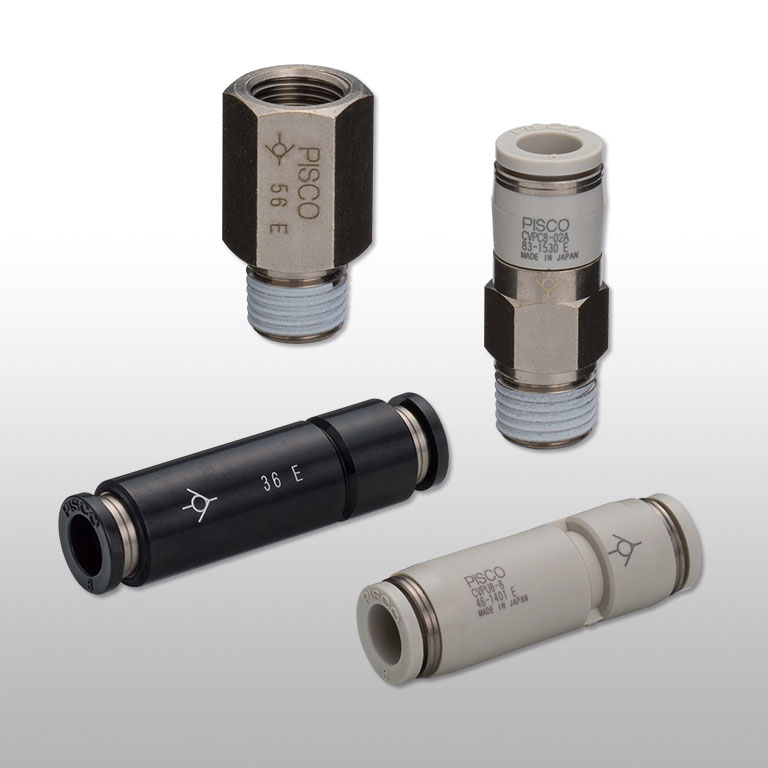
Check Valve permits the air flow in one direction but checks the flow in the opposite direction, thus keeping the output pressure at a constant level.
Advantages
Check Valve permits the air flow in one direction but checks the flow in the opposite direction, thus keeping the output pressure at a constant level.
Usable in vacuum retention state and low-pressure piping.
Low-cost and lightweight resin type.
Low cracking pressure type, which operates at a lower pressure than the standard type, is also available.
See Check Valve with Low cracking pressure (minimum operating pressure: 0.5 kPa).
Specifications
Metal type
| Fluid medium | Air |
|---|---|
| Max. operating pressure | 0.9MPa |
| Max. vacuum | -100kPa |
| Min. operating differential pressure (*) | 0.01MPa or less |
| Min. opening differential pressure | 0.02MPa |
| Operating temperature range | 0 to 60℃ (No freezing) |
*Min. opening differential pressure is the pressure when the valve begins to open, but not the pressure when the valve is fully open.
Resin type
| Fluid medium | Air |
|---|---|
| Max. operating pressure | 0.9MPa |
| Max. vacuum | -100kPa |
| Min. operating differential pressure (*) | 0.01MPa or less |
| Min. opening differential pressure | 0.04MPa |
| Operating temperature range | 0 to 60℃ (No freezing) |
*Min. opening differential pressure is the pressure when the valve begins to open, but not the pressure when the valve is fully open.
Port size
Tube dia.
| mm size (mm) | φ4, φ6, φ8, φ10, φ12 |
|---|---|
| inch size | φ5/32, φ1/4, φ5/16, φ3/8, φ1/2 |
Thread size
| Metric male thread | M5x0.8, M6x1 |
|---|---|
| Taper pipe male thread | R1/8, R1/4, R3/8, R1/2 |
| UNF Thread | 10-32UNF |
| NPT Thread | NPT1/8, NPT1/4, NPT3/8, NPT1/2 |
Construction

Type & Price list
Detailed Safety Instructions
Warning
1.Frequent switching of the valve plug may cause the unit to heat up, which may result in thermal burns. Consult with PISCO if the operation frequency is high.
Caution
1.When tightening the threaded body, be sure to follow the instructions "10. Mounting instructions" of "Common Safety Instructions for Products Listed". Over-tightening may cause malfunction of the valve plug.
2.If the valve is used under conditions where the differential pressure between the primary and secondary sides is extremely large (e.g., the secondary side is open to the atmosphere), the impact during operation may cause the valve plug to break, and in the worst case, the fragments may flow into downstream.
3.Depending on the operating pressure and flow rate, chattering of the valve plug may cause abnormal noise.
4.Do not use the product in a way that requires zero leakage, as it allows for leakage.
Inquiries about this product
It is also possible to suggest products suitable for various conditions such as applications and functions. Please feel free to contact us or visit the nearest sales office.
The following are frequently asked questions. Please check before making inquiries.